How AI4Padel decides who to invite
When a match is one player short, the most common method in clubs is the fastest one: a message to the group, and the first to reply gets in. The problem is that the first to reply is almost never the one who fits: it’s whoever happened to be looking at their phone. If their level is far from the other three, the match comes out lopsided. And a lopsided match burns all four at once: the strong one gets bored, the ones out of their depth get frustrated, and all four think twice before signing up again.
AI4Padel uses a different method: every name it proposes carries its reason, written right next to it. This is what it looks like on screen:
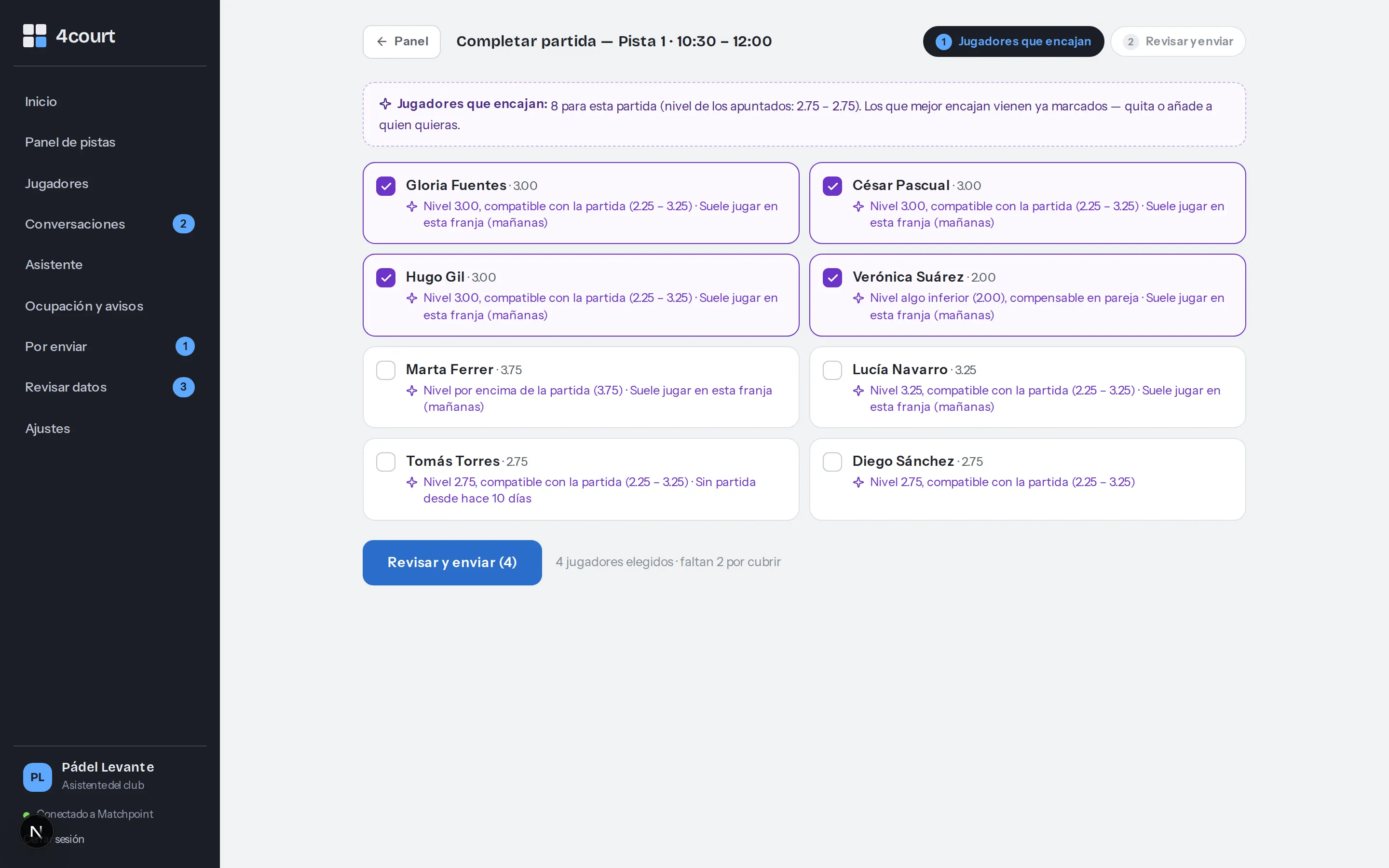
Completing a match in AI4Padel: eight players who fit, each with its why, the four best already ticked. The product runs in Spanish; quotes below come with a translation.
What it checks before proposing a name
- The level, and where it came from. A level the club set after watching someone play, one that came from Matchpoint or your spreadsheet, and an estimated one don’t deserve the same trust. So the player card always states the origin: set by the club, from Matchpoint, or estimated. You know how much to lean on it before deciding.
- Court side, and the balance of the four. Right side or left side, and how the match shapes up pair against pair. It’s not enough for each player to be good on their own: the four together have to make an even match.
- The hours they actually play. What a member declared when signing up is one thing; when they actually step on court is another. The demo club has a textbook case: his card says he prefers midday, yet 100 % of his matches fall on weekends. To fill a Saturday-morning slot, the second one matters more.
- Who they have played well with. Mixes that worked get repeated; the ones that ended badly don’t.
- How often they say yes. Whoever tends to accept gets asked before whoever never replies. Your time counts too.
- How long since their last match. A member who has been off court for a couple of weeks gets a small push up the list: inviting them fills today’s gap and keeps them from drifting away. A weekly member is worth around 300 € a year (one match a week at about 6 € per player): don’t let one slip without at least trying.
Every name with its reason
No magic list. Under each name there is a plain sentence, the same ones you can see in the screenshot above:
- «Nivel 3.00, compatible con la partida (2.25 – 3.25)»: level 3.00, compatible with this match. Their level against the real range of the players already in, not against a generic label.
- «Suele jugar en esta franja (mañanas)»: usually plays at this time, mornings. What their matches say, not their form.
- «Sin partida desde hace 10 días»: no match in the last 10 days. The push for the one who has been off court a while.
- «Nivel algo inferior (2.00), compensable en pareja»: slightly lower level, workable with the right partner. When something isn’t perfect, it says so.
And when someone doesn’t fit, it says that too: on that same screen, Marta shows up unticked with her reason, «Nivel por encima de la partida (3.75)», a level above this match. You can still pick her. It’s your club.
The best ones come pre-ticked
For the match in the screenshot there are eight players who fit, and the four best come already ticked. You can untick anyone, tick someone else, or close the screen and send nothing. When you press «Revisar y enviar» (review and send), the next thing you see is the exact message each player will get, built from your templates and signed with your name. «Tú decides qué se envía»: you decide what gets sent. That line is written into the product, literally.
The difference with messaging the group isn’t just speed: it’s that here you choose among the people who fit, not among the people who were looking at their phone.
The list comes out the same every time
There is no roulette here. Given the same data, AI4Padel proposes the same names in the same order. Ask for the list twice and it comes out identical. That’s why we show it live in demos without fearing what might come out, and why every name can carry a written reason.
What the AI does
AI4Padel’s AI understands your members when they write: “anything tomorrow? we’re two” is a request for two people, and it gets prepared or resolved depending on what you automated. And when picking players it does not improvise: it applies your club’s criteria, with the reason written under every name. If one day you disagree with a suggestion, you’re not left guessing: the reason is right there, and you can overrule it.
Each player’s card
All of the above lives in each player’s card. And when it’s missing data, it says so:
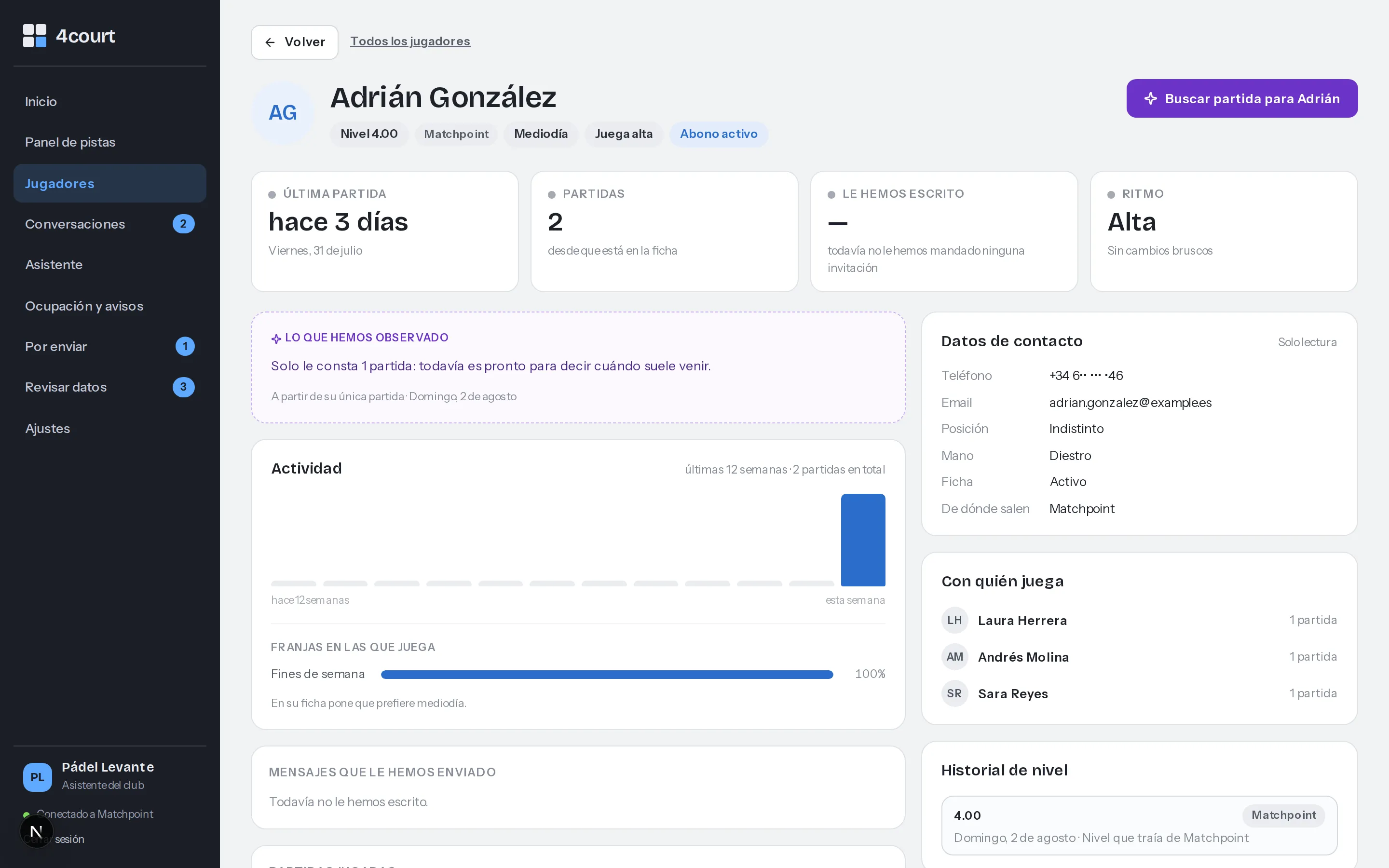
Adrián’s card in the demo club: level with its origin, real hours next to the declared ones, and an honest warning.
Adrián’s card reads level 4.00, with a chip stating where it came from: Matchpoint. The level history keeps every change with its date and origin, «Nivel que traía de Matchpoint», the level he brought over. And the observations block sells no smoke: «Solo le consta 1 partida: todavía es pronto para decir cuándo suele venir», only one match on record, still too early to say when he usually comes. While there isn’t enough history, the list leans on what the player declared, and the card warns you it’s early.
Who never shows up
Two fixed absences, no exceptions:
- Anyone who opted out of messages. Not a warning you can click past: a block. Their name enters no proposal.
- Anyone with no phone number on their card. Without a number there is no invitation to send, so they are never offered.
And when you miss someone on a list, their card tells you why they’re not there and what would change it: adding the missing number, or the member giving their permission again.
And it learns from the result
After the match, players are asked how it went, and that rating feeds into the next list.
Want to see this screen with your real members instead of a demo club’s? Book a 15-minute demo and we’ll pull the list from your data: every name, with its why.